Quick Answer
This guide is for PKI administrators, security architects, and compliance teams implementing NIST-aligned certificate management.
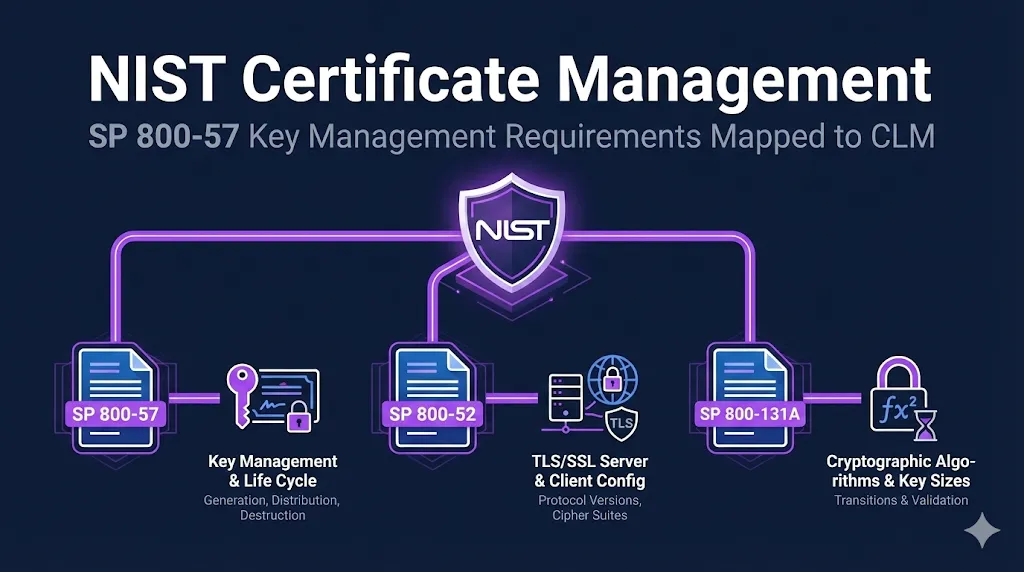
NIST Special Publications (SP 800 series) define cryptographic standards used by U.S. federal agencies and widely adopted by enterprise organizations globally. For certificate management, three key publications matter:
- SP 800-57 — Key management lifecycle (generation → destruction)
- SP 800-52 — TLS configuration requirements (protocol versions, cipher suites)
- SP 800-131A — Algorithm transitions and deprecation timelines
💡 Key Insight: Even if you're not a federal agency, NIST standards are the baseline for most industry frameworks (PCI DSS, HIPAA, FedRAMP) and are increasingly required by enterprise customers and auditors.
Introduction to NIST Standards
The National Institute of Standards and Technology (NIST) develops cryptographic standards that form the foundation of secure communications for the U.S. government. However, NIST's influence extends far beyond federal agencies.
Why NIST Matters Beyond Government
Enterprise Adoption
Fortune 500 companies, financial institutions, and healthcare organizations use NIST as their cryptographic baseline, even without federal mandates.
Regulatory References
PCI DSS, HIPAA, SOC 2, and FedRAMP all reference NIST guidelines. Meeting NIST often means meeting multiple compliance requirements.
Global Recognition
NIST standards are recognized internationally and often align with ISO/IEC standards, simplifying global compliance efforts.
Supply Chain Requirements
Government contractors and their suppliers must meet NIST requirements, cascading compliance throughout supply chains.
SP 800 Series Overview
| Publication | Title | Certificate Relevance |
|---|---|---|
| SP 800-57 | Recommendation for Key Management | Key lifecycle, cryptoperiods, protection levels |
| SP 800-52 | Guidelines for TLS Implementations | TLS versions, cipher suites, certificate requirements |
| SP 800-131A | Transitioning Use of Cryptographic Algorithms | Algorithm deprecation, migration timelines |
| SP 800-63 | Digital Identity Guidelines | Authentication assurance levels, certificate binding |
SP 800-57: Key Management Framework
SP 800-57 is a three-part publication that defines how cryptographic keys should be managed throughout their lifecycle. For certificate management, it provides the foundational framework for key states, protection requirements, and cryptoperiods.
Key States & Certificate Lifecycle Mapping
NIST defines key states that map directly to certificate lifecycle phases. Understanding these states helps align your CLM processes with NIST requirements.
| Key State | NIST Definition | Certificate Equivalent | CLM Action |
|---|---|---|---|
| Pre-activation | Key generated but not yet authorized for use | CSR submitted, pending approval | Track pending requests |
| Active | Key may be used for cryptographic operations | Certificate issued and in use | Monitor for expiry, rotate as needed |
| Suspended | Temporarily disabled, may be reactivated | Certificate temporarily revoked (hold) | Investigate, plan remediation |
| Deactivated | No longer used for applying protection | Certificate expired or superseded | Archive, remove from active systems |
| Compromised | Private key exposed or suspected | Certificate revoked for key compromise | Immediate revocation, emergency replacement |
| Destroyed | Key material securely erased | Certificate removed from all systems | Confirm deletion, audit trail |
Cryptoperiods
A cryptoperiod is the time span during which a key may be used. NIST recommends maximum cryptoperiods based on key type and use case. These directly impact certificate validity periods.
| Key Type | Max Cryptoperiod | Certificate Implication |
|---|---|---|
| Symmetric encryption key | 2 years | N/A (session keys) |
| Private signature key | 1-3 years | Certificate validity ≤ 3 years |
| Public key (certificate) | 1-3 years | Max 398 days for public TLS (BR requirement) |
| CA signing key | 6-25 years | Root CA validity, plan for rotation |
| Key transport key | 2 years | Key encipherment certificates |
Important: CA/Browser Forum Baseline Requirements now limit public TLS certificates to 398 days (effective Sept 2020), which is more restrictive than NIST's general recommendations. Always apply the more restrictive requirement.
Algorithm Recommendations
Approved Algorithms
- • RSA 2048+ (3072+ recommended)
- • ECDSA P-256, P-384, P-521
- • SHA-256, SHA-384, SHA-512
- • AES-128, AES-192, AES-256
Disallowed Algorithms
- • RSA < 2048 bits
- • SHA-1 for signatures
- • MD5 (any use)
- • DES, 2TDEA (2-key 3DES)
SP 800-52: TLS Guidelines
SP 800-52 Rev. 2 provides specific guidance for implementing TLS in federal information systems. It covers protocol versions, cipher suites, and certificate requirements that directly impact your certificate management practices.
Minimum TLS Version Requirements
TLS 1.3
Preferred for all new implementations
RecommendedTLS 1.2
Minimum acceptable version, with approved cipher suites
AcceptableTLS 1.0/1.1, SSL
Prohibited - must not be used
ProhibitedCipher Suite Requirements
| Status | Cipher Suites | Notes |
|---|---|---|
| preferred | TLS_AES_256_GCM_SHA384 TLS_AES_128_GCM_SHA256 TLS_CHACHA20_POLY1305_SHA256 | TLS 1.3 cipher suites, AEAD only |
| acceptable | TLS_ECDHE_ECDSA_WITH_AES_256_GCM_SHA384 TLS_ECDHE_RSA_WITH_AES_256_GCM_SHA384 | TLS 1.2 with ECDHE and GCM |
| deprecated | TLS_RSA_WITH_AES_256_CBC_SHA256 TLS_DHE_RSA_WITH_AES_256_CBC_SHA | Non-AEAD modes, static RSA key exchange |
| prohibited | TLS_RSA_WITH_3DES_EDE_CBC_SHA TLS_RSA_WITH_RC4_128_SHA All SSL 3.0/TLS 1.0/1.1 suites | Weak algorithms, broken protocols |
Certificate Requirements for TLS
- Key Size: RSA ≥ 2048 bits, ECDSA P-256 or higher
- Signature Algorithm: SHA-256 or stronger hash
- Certificate Chain: Complete chain must be served, including intermediates
- Revocation: OCSP stapling recommended, CRL distribution points required
- Extended Validation: EV not required, but proper validation (DV/OV) essential
SP 800-131A: Transitioning Algorithms
SP 800-131A Rev. 2 provides the timeline for transitioning away from deprecated cryptographic algorithms. This is critical for certificate management as it defines when algorithms become unacceptable for federal use.
Algorithm Transition Timeline
| Algorithm | Status | Transition Date | Required Action |
|---|---|---|---|
| SHA-1 (signatures) | Disallowed | Jan 1, 2014 | Use SHA-256 or higher |
| RSA 1024-bit | Disallowed | Jan 1, 2014 | Use RSA 2048+ or ECC |
| RSA 2048-bit | Acceptable through 2030 | Dec 31, 2030 | Plan migration to 3072+ or ECC |
| ECDSA P-256 | Acceptable | Ongoing | Preferred for most use cases |
| ECDSA P-384 | Preferred | Ongoing | Required for high-security applications |
| 2TDEA (2-key 3DES) | Disallowed | Jan 1, 2024 | Use AES-128+ or ChaCha20 |
| 3TDEA (3-key 3DES) | Deprecated | Dec 31, 2023 | Migrate to AES |
Post-Quantum Considerations
Forward Looking: NIST has standardized post-quantum cryptographic algorithms (ML-KEM, ML-DSA, SLH-DSA) that will eventually replace current algorithms. While not yet required, organizations should begin planning for crypto-agility.
Learn more about PQC transition planningNIST → CLM Controls Mapping
Use this mapping table to align your certificate lifecycle management practices with specific NIST SP requirements. This helps demonstrate compliance during audits.
| NIST Requirement | SP Reference | CLM Implementation | Resource |
|---|---|---|---|
| Key generation controls | SP 800-57 | CSR validation, key size enforcement | CSR Builder Guide |
| Cryptoperiod enforcement | SP 800-57 | Certificate validity tracking, renewal automation | Certificate Lifecycle Guide |
| Key state transitions | SP 800-57 | Revocation workflows, decommissioning procedures | Revocation Deep Dive |
| TLS version compliance | SP 800-52 | Protocol scanning, configuration validation | TLS Comparison Guide |
| Cipher suite configuration | SP 800-52 | Server configuration templates, compliance scanning | Cipher Suite Decoder |
| Algorithm deprecation | SP 800-131A | Weak key detection, migration tracking | RSA vs ECC Guide |
| Certificate chain validation | SP 800-52 | Chain building, intermediate management | Chain Builder Guide |
| OCSP/CRL implementation | SP 800-52 | Revocation checking configuration, stapling | Revocation Guide |
Implementation Checklist
Immediate Actions
This Week- Inventory all certificates using SHA-1 signatures—these must be replaced
- Identify any RSA 1024-bit or smaller keys still in use
- Verify TLS 1.0 and 1.1 are disabled on all public-facing services
- Check for 3DES cipher suites still enabled
Short-Term Actions
30-90 Days- Deploy certificate discovery across all environments
- Establish baseline cipher suite configurations per NIST SP 800-52
- Document cryptoperiod policies aligned with SP 800-57
- Implement automated alerting for certificate expiry (90/60/30/7 days)
- Create migration plan for RSA 2048 → RSA 3072 or ECC by 2030
Ongoing Activities
Continuous- Quarterly TLS configuration scans against SP 800-52 requirements
- Annual review of cryptographic algorithms against SP 800-131A updates
- Monitor NIST publications for new guidance and transitions
- Track post-quantum cryptography developments and prepare for migration
- Maintain audit trail of key lifecycle events per SP 800-57
Benchmark Your Readiness
Take our comprehensive assessment to score your PKI governance maturity and get prioritized recommendations.
Take the Maturity AssessmentCross-References
Related Internal Guides
Post-Quantum Cryptography Guide
Preparing for PQC transition
Crypto Agility Guide
Building algorithm flexibility
RSA vs ECC Guide
Algorithm selection criteria
TLS 1.2 vs 1.3 Comparison
Protocol differences and migration
Certificate Lifecycle Guide
Managing certificate states
DORA Certificate Management
EU financial services compliance
If You Only Do Three Things...
Short on time? Focus on these three priorities to align with NIST requirements:
Eliminate Weak Crypto
Find and replace SHA-1, RSA 1024, 3DES—they're already disallowed.
Enforce TLS 1.2+
Disable TLS 1.0/1.1 and use only approved cipher suites.
Track Cryptoperiods
Automate expiry alerts and enforce key rotation schedules.